Beryl Walker
Beryl Walker
Beryl and her twin sister Margaret were born in 1946 at their mother’s mother’s house in Park Avenue Coxhoe in 1946. Shortly after their birth Beryl and her sister went home to live with their mum and dad; John and Molly Arkwright in Metal Bridge.
John and Molly, Beryl and Margaret’s parents, were married at St Mary’s Church Coxhoe in 1942. After they married John and Molly set up home in Metal Bridge. Metal Bridge is a hamlet just outside West Cornforth, close on the way to Thinford.
Tursdale Colliery where Beryl’s father John worked is also nearby. John’s job was as a bank hand in the lamp cabin. All the miners started their shift at the lamp cabin. They handed in a metal tally and were given a safety lamp in exchange. The tallies were hung on a board which provided the record of how many men were down the pit at one time. At the time Beryl’s father worked there Tursdale was part of Bowburn Colliery. Over two thousand men worked underground.
Mines had existed in and around the location of Metal Bridge since mediaeval times. At the time Beryl and her twin sister were born in 1946 the original pit had been worked out. A new pit; Metal Bridge Drift was sunk in 1952 by the National Coal Board.
Metal Bridge takes its name from the iron bridge that carries the East Coast Main Train Line from London to Edinburgh. Metal Bridge is a small industrial settlement. Railway Street is the main street running through the hamlet. Beryl lived with her family in the distinctive nineteenth century cluster block housing that was behind Railway Street. The homes were basic in many ways without hot water, or indoor lavatories, but there was a strong community spirit. Beryl, like most people who grew up there, enjoyed living in ‘the blocks’ in Metal Bridge.
Beryl remembers going to East Howle School which was in walking distance of her home, on the road between East Howle and Metal Bridge and attending Sunday School at the iconic tin chapel which was a little further down the road than the school towards East Howle. The Chapel had a lay preacher who lived in Durham. His name was Mr Simpson. Beryl recalled sitting on the high window sill of another church that was quite near, watching the world go by and getting into bother for climbing up there.
Saturday was bath night at Metal Bridge for Beryl and her twin sister Margaret.
Sadly Beryl’s father, John died, aged 43 from stomach cancer when Beryl was seven. Life was very difficult for Molly, Beryl’s mother, who worked hard to provide and care for her two young daughters. Molly had worked at the cinema in Coxhoe and at the factory.
Molly became caretaker at East Howle School. Beryl walked with her twin sister Margaret from Metal Bridge to East Howle when her mother worked at the school.
Beryl also went to Cornforth with her mother on Tuesdays to shop at Walter Wilson’s and Peg’s Pies. One of her favourite places was Redcar where her mother took them when she could afford it.
Beryl became ill with jaundice and, because it was believed the cause was contagious, and placed her sister Margaret at risk, Beryl moved from her home in Metal Bridge to her grandmother’s house in Park Avenue where her grandmother could give her the care she needed.
Beryl left East Howle School when she was eleven, and transferred to Bowburn Secondary School while continuing to live in Park Avenue at her grandmother’s house.
On leaving school Beryl and her sister began work at the clothing factory in Ferryhill. Margaret enjoyed the job allocated to her but the job Beryl was assigned didn’t suit her at all. It wasn’t long before Beryl found herself a job at Smart and Brown’s factory in Spennymoor. Beryl’s job was to wire the plates that went on to cooker hobs. This suited her much better.
Beryl and her close friend Marjorie who lived in Bowburn enjoyed going to the weekly dances in Durham Town Hall. Marjorie and Beryl’s mothers had been life-long friends, sharing many milestones together; marrying at similar times and becoming pregnant at the same time though Beryl’s mother went one better than her friend by having twins.
It was at one of the dances that Beryl and Marjorie went to in the Town Hall in 1964 that Beryl met her future husband; Alan Walker. Alan was a Sherburn lad who worked at Steetley quarry. Alan and Beryl planned to marry in 1967. They bought a house next door to Beryl’s mother in Metal Bridge. Beryl was looking forward to living next door to her mother.
Sadly that was not to be. Beryl’s mother became ill and died in 1965 aged 44. It was some years later that Beryl discovered that her mother had died of ovarian cancer. Margaret needed a home. Beryl and Alan brought their wedding forward; marrying the next year. This made it possible for Margaret to move to Coxhoe where she could have Beryl’s old room at her grandmother’s house.
Beryl and Alan settled down to married life in Metal Bridge. They were happy living there as part of a supportive community. Alan and Beryl’s first child Neil was born a year after they married and Karen completed their family. Beryl recalled how their home in Metal Bridge could be very cold. The windows iced up in winter and the ice had to be scraped from the window pane.
Alan, Beryl their family and their neighbours had to find new homes when the houses they were living in were compulsorily purchased and demolished. Beryl moved with her family to West Cornforth and made the most of the amenities of their new house and quickly made it home.
Karen was christened in Station Road Methodists. When the children became a little older Beryl looked for work outside their home. It had to be work that fitted in with the children’s time at school. Beryl took a job at Mrs Kitchen’s fish shop working two lunchtimes a week, one of which, was, of course, Friday. The Kitchens were lovely people. Beryl’s nana came over from Coxhoe to look after the two children; Neil and Karen, when Beryl worked at the fish shop.
While Beryl was working at the fish shop, which she enjoyed, the caretaker at the primary school approached her and asked if she would like to cover the work of one of the school dinner ladies who was ill. Beryl was looking for extra work, her children were at the school, school hours suited her and she took it on.
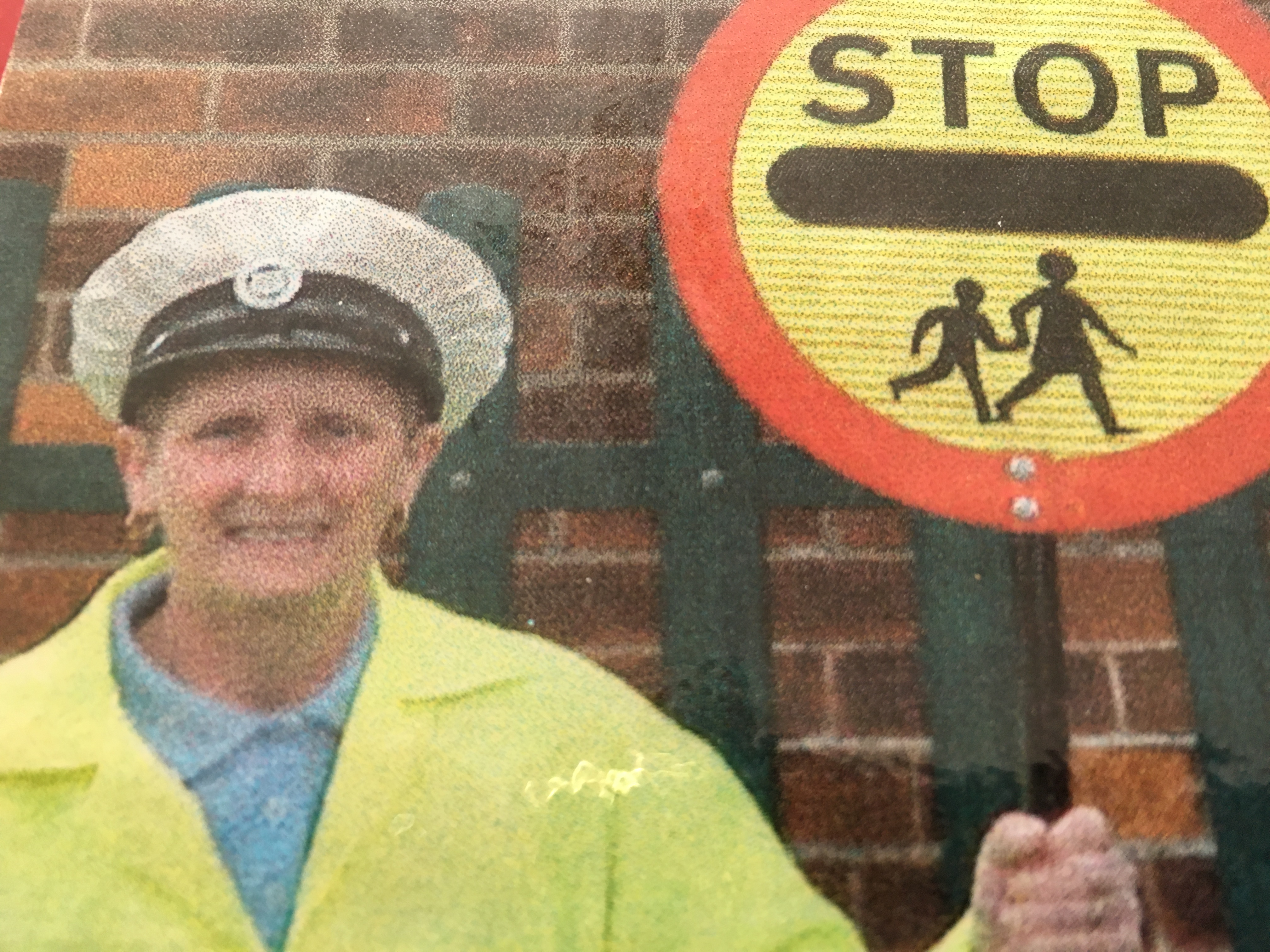
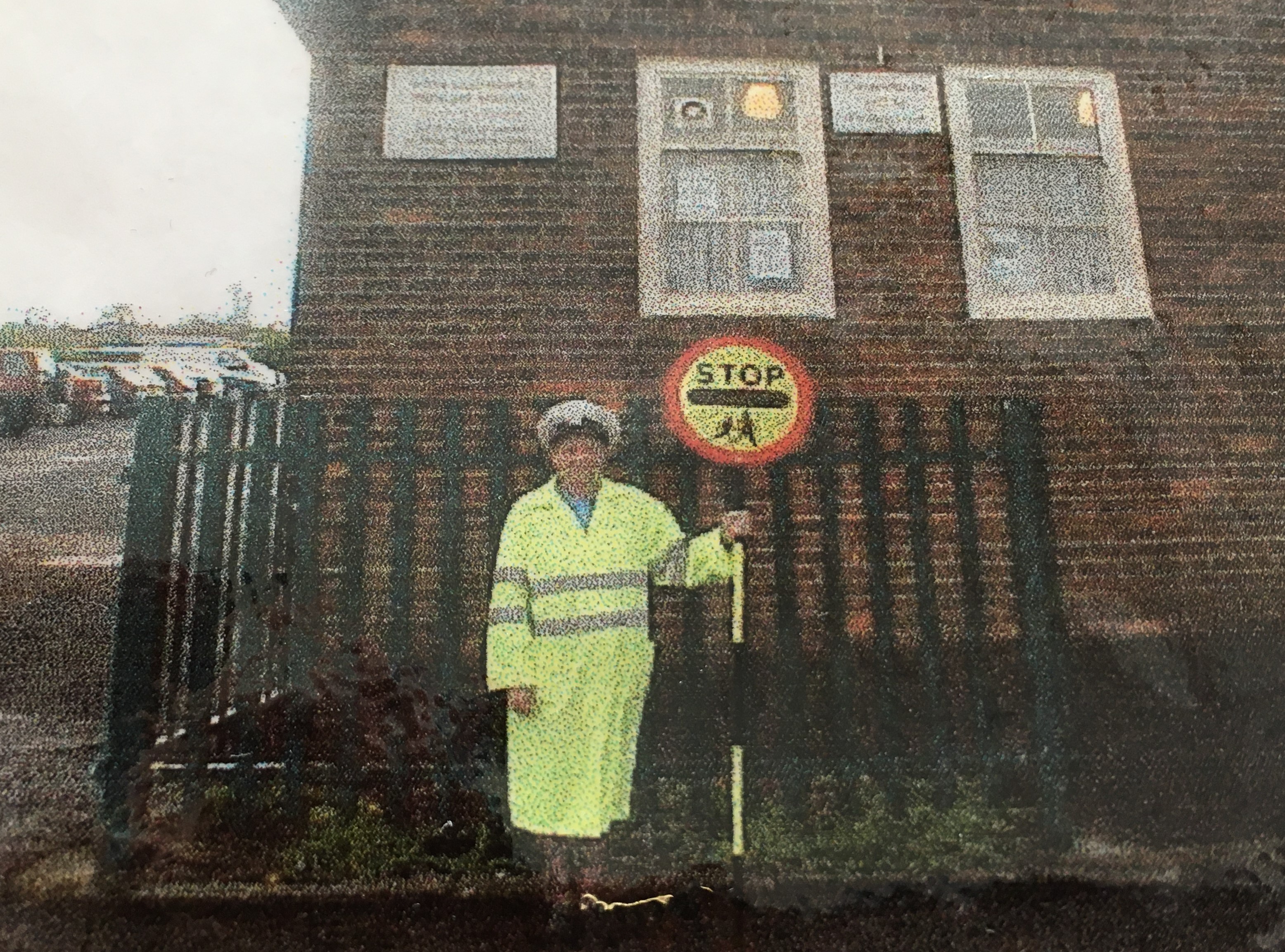
In 1982 the position of school ‘lollipop lady’ became vacant. Beryl applied and was successful. It was a job that she embraced and held for almost thirty years. Beryl helped hundreds of children safely across the road. Mr Clark was the head teacher at the time Beryl took on the post, followed by Miss Reekie and Mrs Sarsfield who was head teacher when Beryl retired. Nothing phased Beryl, not the snow or the rain. Mrs Sarsfield said that Beryl was an important part of the school, not just helping children safely across the road but forming a school travel plan, and helping at school events. Mrs Sarsfield described Beryl as reliable, popular, and supportive
Beryl described how the job changed over the years; with increased levels of traffic and acknowledged that not all drivers were as patient as they might have been but with a balance of firmness and patience she kept them in line and the children safe.
Beryl was taught to cross the road by a much loved local policeman when she was quite young.
The part of the job Beryl liked best was getting to know the children, talking to them each day as they grew up, meeting them round the village as adults and as time went on helping keep their children safe as they crossed the road.
Beryl loved her title ‘Lollipop Lady’. The children of the village loved their lollipop lady too
I remember Beryl very well and still to this day have a lovely relationship with her.
Beryl lovely lady.
Lovely lady we used to have a good laugh.
Lived next door to Beryl many years ago in Cedar Terrace, lovely lady.
I remember Sadie the lollipop lady all the children loved her also Beryl both lovely women.
The official duties of the school crossing patrol officer, affectionately known as a ‘lollipop lady’ (or man) because the sign they carry resembles a large lollipop, are concerned with halting traffic and once it is safe to do so signalling to waiting children that it is safe to cross the road.
However the best lollipop ladies and men are so much more than that; they provide a welcome smile, and engender a feeling of safety and worth in children when they arrive at, and leave school for the day.
Shortly before she retired Beryl’s twin sister Margaret became seriously ill. While Beryl and Margaret were told that their mother had died of cancer, the type of cancer and implications for other family members were never raised or discussed. Margaret was diagnosed with ovarian cancer and the doctor asked Beryl if the condition ran in the family. Beryl wasn’t aware that ovarian cancer could ‘run in families’ but as she thought about Margaret’s developing symptoms she realised they were very similar to those suffered by their mother. Beryl sought out her mother’s death certificate and discovered that ovarian cancer was given as the cause of death. It looked as if the condition ran in the family.
Beryl explained that while no mother would choose to leave a legacy like that actually knowing about the possible risk has enabled other female members of the family to take the necessary steps to protect themselves from this deadly disease.
Sadly this insight came too late to help Margaret who died in 2006 and is sadly missed.
As much as Beryl loved her job as ‘lollipop lady, she is first and foremost a wife, mother and proud grandmother. Neil started work at Cockerill’s butchers as a slaughter man and then became a quarryman like his dad. Karen is the supervisor at Locomotion. Neil has two boys and Karen one. Beryl and Alan are devoted grandparents.
Beryl likes reading, walks every morning and likes to go on holiday. Her favourite places are Jersey and Blackpool where they stay at the Elgin Hotel. The pandemic meant that Beryl couldn’t go and see Cliff Richard but that has been postponed and is something she has to look forward to.
Beryl and Alan were talking to Julie Leitheiser September 2020