Jen Wilson
Jenny Wilson
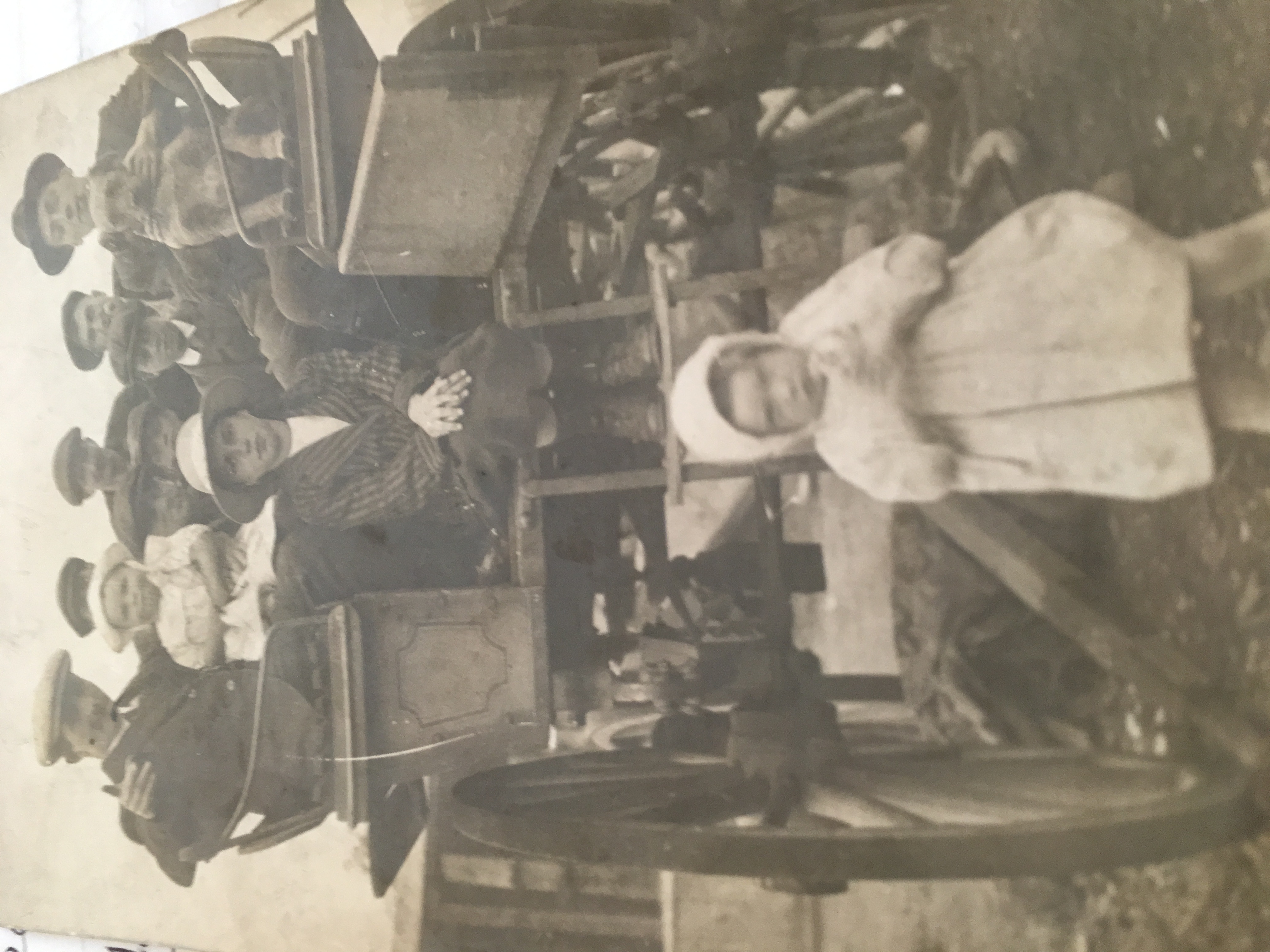
Jenny was born in 1919. Jenny’s father had started work at the pit but came out of the pit when he took over his brother’s horse and carts. Her father kept his horses at the Balaclava which wasn’t too far from the family home; 66 High Street, a large four bedroomed apartment above two lock up shops; a draper’s and men’s tailors. The men’s tailors run by Hannah McFadden moved to Spennymoor.
Wilson Bell had a small lock up shop next door. A little further down the street on the other side was Santis Ice Cream shop. The Santis sold up and moved to Fishburn. There was a fish shop over the road. Fish and chips cost thru’pence (3d).
There were four public houses between Jenny’s home and the market place; The Kings Head run by the Gibbons, the Queens Head run by the Rosethornes, and the Good Intent later run by Mary Smart.
There were houses up steps opposite Jenny’s house, the Salvation Army was just below them.
Jenny remembers Edward Hunt and Frances’ shops further on in the village that sold wall paper and paint. Paper cost twopence (2d) a roll.
Jenny’s father used a flat cart to help with the delivery of parcels which he collected each morning from the station. Mr Wilson delivered to East Howle, Metal Bridge, Coxhoe, Tursdale, Cassop, Bowburn, and Kelloe as well as West Cornforth. He was paid three farthings for deliveries to Cornforth, twopence (2d) for deliveries to Coxhoe, thre’pence (3d) for deliveries to Kelloe and Bowburn, and fourpence (4d) for deliveries to Quarrington Hill and Cassop. (1p equals 2.5d)
Jenny recalls taking the bus to Cassop to deliver a parcel for her father. The person receiving the parcel was required to pay the delivery charge of sixpence (6d) and refused. Jenny had to return the parcel to Coxhoe Bridge Station.
Jenny’s father also had a horse drawn hearse. For funerals he changed into a High Shiner ( a top hat) which was kept in a leather box.
The brake was Jenny’s favourite cart. It was used to take people on outings. A popular trip was a day at the seaside when they went off to Blackhall Rocks.
Jenny’s mother went to the school that was on The Green. The school on the Green had closed. By the time Jenny was of school age and so she went to Regent School which was just off the pit bank. Younger children were taught downstairs. Different classes were held in the corners of the Big Room. There were eight junior classes and ten senior classes. The Junior School headmistress was Miss Wilkinson.
A new school, which had individual enclosed classrooms was built in the village while Jenny was part way through her education. Jenny can remember carrying her books in crocodile with the other children to the new school. Jenny enjoyed school; she loved maths, didn’t feel she was any good at drawing and never liked history. Jenny liked Geography. Jenny was never absent or late for eight years 7 months.
Jenny was presented with pictures for her good attendance.
Jenny went to school one Wednesday morning but went home in the afternoon as the nurse called her mother to say Jenny was ill. Jenny went home that afternoon but returned to school after three days. That was her only absence all the time she was at school.
Jenny’s parents also took in lodgers. One day a young woman got off a bus at the Balaclava and made enquiries about where she might get a cup of tea. ‘There are nae cafes in Doggie. Nivver mind I’ll tak thee where you might get a cup of tea’ the young woman was told. Miss Guthrie was brought to Jenny’s mam.
Miss Guthrie explained that she was a newly qualified teacher and had been offered a place at the school. Miss Guthrie’s home was in Crawcrook and it had taken her three and a half hours to get to Cornforth. There was no way that she could travel to and from school in a day. Miss Guthrie had come that day to look for lodgings.
There was no room at Jenny’s all the lodging rooms were taken. It was 1930 and electricity was being brought to the village. Four of the electricians who were installing the electricity came from Newcastle. Jenny has clear memories of the gas man doing his rounds in the village lighting up in the evening and shutting off the gas in the morning.
Jenny’s parents gave Miss Guthrie the names of people who might have been able to give her board and lodgings. Miss Guthrie had dinner with the family and went off to see if anyone on her list could offer her somewhere to stay. Jenny’s father told her to come back for a cup of tea before she went home.
Miss Guthrie landed back quite despondent because she couldn’t find anywhere to stay. Jenny’s dad, mindful that two of the men staying with them would be leaving in a fortnight, offered her a place sharing a bed with Jenny until the men returned to Newcastle.
Jenny was terrified at the thought of sharing a bed with a teacher. Nevertheless, her father had spoken the teacher agreed and so Jenny and Miss Guthrie shared. Fortunately they became best friends and continued to share until Margaret (Miss Guthrie) left to get married five years later. They stayed life long friends. Miss Guthrie got a new job in Alnwick where her new husband was a manager at a Brough’s store.
Jenny’s father had three horses at a time. One of the horses died suddenly while standing, because the horse was standing up the insurance company would not pay out. Shortly after that, in the 1930s Jenny’s father bought a motor lorry from Young’s at Chester le Street. It cost £137. The lorry didn’t have any gears and got stuck on East Howle Bank. Jenny doesn’t know what he did to rectify the situation.
Jenny had piano lessons and later lessons on the pipe organ. After four lessons on the pipe organ she was told that she knew the stops and all she needed was practice with her feet. Jenny describes her further development as ‘more or less picking it up’. Jenny played at the organ at the Primitive Methodists’ church during the war taking over from Jim Bowman who had been called up. The choir master was Billy Carrick and assistant choir masters were Mr Welford and Jenny Siddall. Jenny has an electric organ at home and her skills are still in demand.
Jenny left school at fourteen but there were no jobs in West Cornforth. Some of Jenny’s friends went to work in the colleges in York or into service. Jenny stayed at home helping her mother and when she was older secured a job in the offices at Bennett’s grocery store in West Cornforth. Mr Bennet started the business he had two shops as well as travelling shops. It was a good place to work. Stan Carrick drove one of the travelling shops. Quite a few other people worked at Bennett’s. Bennet’s was the first shop to sell Blue Riband wrapped chocolate wafers.
Bennet’s delivered groceries as did other shops such as Brough’s. Journey men went to each customer on a Monday to take orders, on a Tuesday to deliver them and on a Friday to collect payment. People in the shop made up the orders and each journeyman had a particular round. Charlie Sayers was responsible for customers in Spennymoor, Chilton, Bowburn, Kelloe, Cornforth and Coxhoe.
Mr Bennet died in a car accident one morning on his way to work from his home in Sedgefield. The business continued but closed some years later and has now been converted into a bungalow.
Church played a central role in most people’s lives. As well as Holy Trinity Church on the Green, the Catholic Church beside the school, and the Salvation Army there were three non conformist churches, the Primitive in the High Street, the Wesleyan in Station Road, and the New Connections in West Cornforth.
The average congregation was sixty each week. Jenny’s father was an independent Methodist and brought Jenny up as a primitive Methodist. Music was an essential part of worship. Jenny had one or two lessons but was largely self taught and is still accompanying services today in Spennymoor at a church she has attended since the chapels in West Cornforth closed.
Jenny remembers several talented musicians who played in different chapels; Billy Carrick the choir master, Miss Walton, Nellie and Flo Colley were all in demand.
Jenny and her mother moved to Moor Street when her father died and the lodgers left.
After that Jenny moved to the new prefabs which she and her mother found to be very convenient with a cupboard for everything.
At ninety seven Jenny still lives independently in her own home and recalls her parents telling her when she was born that the doctor told her father not to build up his hopes as his daughter was quite frail.
Jenny Wilson July 2016